

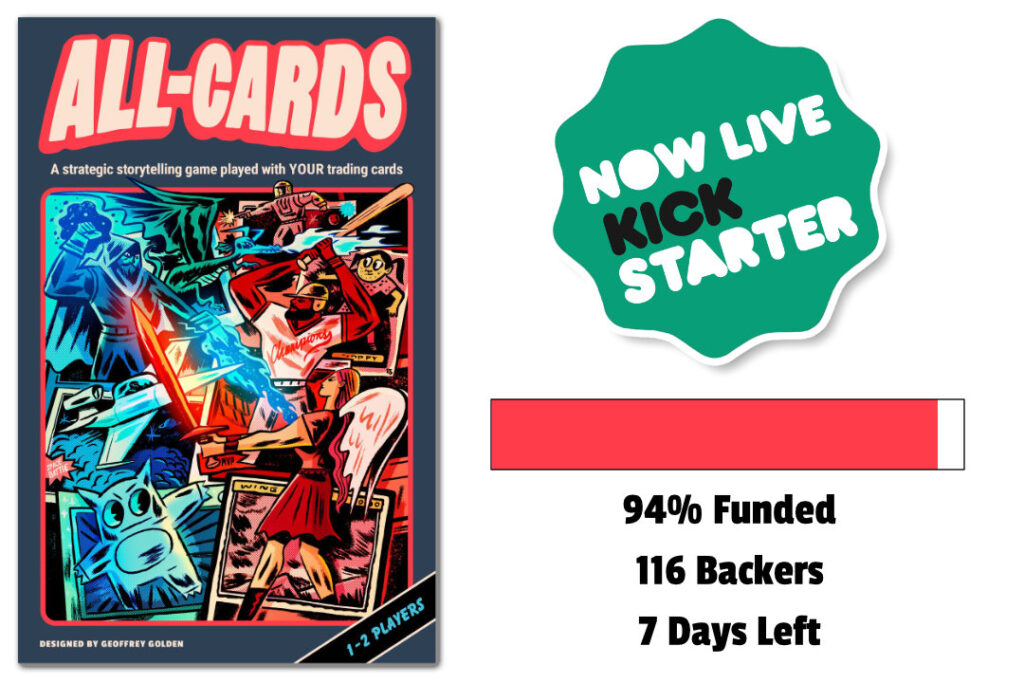
🃏 This is the last week to back my Kickstarter for ALL-CARDS, the trading card storytelling game. I’m getting the word out! My friend Grant Pardee, the very first backer of the campaign (💖), invited me onto his show Sonic Weekly, where we discussed how ALL-CARDS can gamify writing Sonic fan fiction. Then I ventured onto RPG R&D for a rousing discussion on why AI has no place in tabletop game development. For the record, ALL-CARDS was made entirely by humans.
We’re absurdly close to reaching our goal with 94% funding and less than $140 to go!
If you supported the Kickstarter in anyway so far – pledging, sharing, listening to my anxieties every day at lunch (thank you, Amanda!) – I want to give you a sincere thank you.
The good news is we’re almost there. The bad news is that “almost” doesn’t cut it on Kickstarter. If funding isn’t complete by February 27th, the project doesn’t happen. Yikes!
→ If you haven’t already, I’d love if you checked out the ALL-CARDS Kickstarter. Here’s the link.
So many of us have cards lying around our homes that gather dust all day. I know I do. On my closet shelves are childhood basketball cards, forgotten tarot decks, and impulsively purchased Jaws 3-D cards that came with tiny 3-D glasses. (Sick!) I designed ALL-CARDS to give new life to beloved old cards. My hope is that ALL-CARDS will transform your cards into fun new memories at your table.
That was your weekly ALL-CARDS update. Now for the proper newsletter…

After finishing an early draft of ALL-CARDS last year, I realized I had enough time to print it and give it away as a game zine at my first Gen Con. I felt like that was a nice, personal way to debut the game.
Soon after printing my limited run of 30 copies, I realized I had a problem.
The cover wasn’t the issue. The design came out cute. I used an iconographic retro style I was confident I could pull off.
No, it was my interior layouts. They were clean and organized, but… sparse. There were no illustrations! I made a conscious decision not to commission illustrations for the Gen Con version, because I didn’t want to spend a lot of money on a freebie and time was running out before the show. I knew the zine would’ve greatly benefitted from spot illustrations to break-up the walls of text, but I also wanted there to be a zine, so I had to make a compromise.
When I started on the Kickstarter version of ALL-CARDS, I knew the manual needed illustrations. All text wouldn’t cut it for a premium version. Unfortunately, my budget didn’t allow me to hire an illustrator. I had enough to hire a graphic designer, my go-to InDesign genius Mike Reddy, to illustrate a snazzy cover, design a logo, and layout the pages. Mike could make some infographic type images of cards, dice, and assorted icons, but not the kind of cool, large inset illustrations that would make the interiors sing.
If my game was rooted in a genre, this would be no problem. There are tons of historical medieval illustrations to fill a fantasy RPG zine. Early sci-fi short fiction magazines from the 1920s have tons of public domain illustrations to pull from. But my game was about trading cards, which covers a variety of genres. There are sports cards, superhero cards, fantasy cards, gross-out cards, trivia cards, and many more, along with highly specific stuff like card checklists and scratch-and-sniff cards. That’s a lot of ground to cover. When I imagined the trading card collection of my target player, I thought of cards from the 1980s and 90s, and images from that period are largely under copyright.
I considered scanning my collection of Sliders, OverPower, and ALF cards and putting those images into the zine with funny captions. The captions would be key, because in theory, using copyrighted images for the purpose of commentary and criticism is considered fair use. But if I got a cease and desist from Disney, I wouldn’t have the resources to fight them in court, even though I would be legally in the right! Probably, I think! So I’d be forced to pulp a bunch of zines, and as someone who has pulped many zines, I would prefer to never pulp zines again.
Then I had an idea. What if I created fake trading cards to illustrate the book? Vintage trading cards are usually two elements: the central artwork and the border design. I knew my way around Affinity enough to create shameless knock-offs loving tributes to trading card border designs, which were pretty simplistic. A color border. A text box. A text-based logo. Doable. But that didn’t solve my art problem. What would be the “meat” of the cards?
My first idea was to call a movie licensing agency. A decade ago, when I co-created the Wet Hot American Summer TTRPG, I met some folks at an agency that had the merchandising rights to 1980s movies like The Terminator and Bill & Ted’s Excellent Adventure. So I emailed them and asked how much they would charge to license screenshots from their movies for a short print run of a black and white zine.
The lady in charge said their floor, the absolute lowest she would go, was $5,000. Per image. I thanked her for her time, then saw myself out of her inbox.
My next idea was more fruitful. On the Internet Archive, you can download vintage CD-ROMs containing thousands of royalty free images and clip art. I decided to use a vast collection from a company that’s still in business and has the terms of use for their stock photos on their website, which I followed. What’s great about vintage stock photography is that all the images have an authentic retro feel to them. They are actually from the period.
The biggest problem I had was technical. The images on the CD-ROMs were in a file format so old, it was unreadable by Affinity. I had to dig quite a bit to find a shareware program called Graphic Converter, which I remember using in high school and was surprised it was still being updated. Graphic Converter was able to convert Kodak Photo CD images to JPEGs. Do you remember going to the drug store to pick-up your pictures as physical photos, negatives, and an accompanying Photo CD? All in a cardboard sleeve? That’s the format they were in. Never has a file format been such a time machine for me.
I formatting the rules text into a document at my desired trim size: 5.5 x 8.5 inches, my go-to trim size from my publishing days. This told me the book’s length would be roughly 30 pages. So I decided to make 20 fake trading cards, which I figured would be enough to put one card on all 15 spreads, plus special cards to illustrate the card categories. In ALL-CARDS, players sort their cards into categories to give them special abilities. For example, I made a Yankee Stadium card to illustrate the “Setting” category. (And for the heck of it, I made the card autographed by Ted Kaczynski.)
Browsing through the stock photo library, I looked for images that inspired me. One thing I was looking for was an image that could be a movie still, because a lot of vintage trading cards were based on movie stills. I found one of a scuba diver and thought, “This could be an early scene in an alien horror movie…”
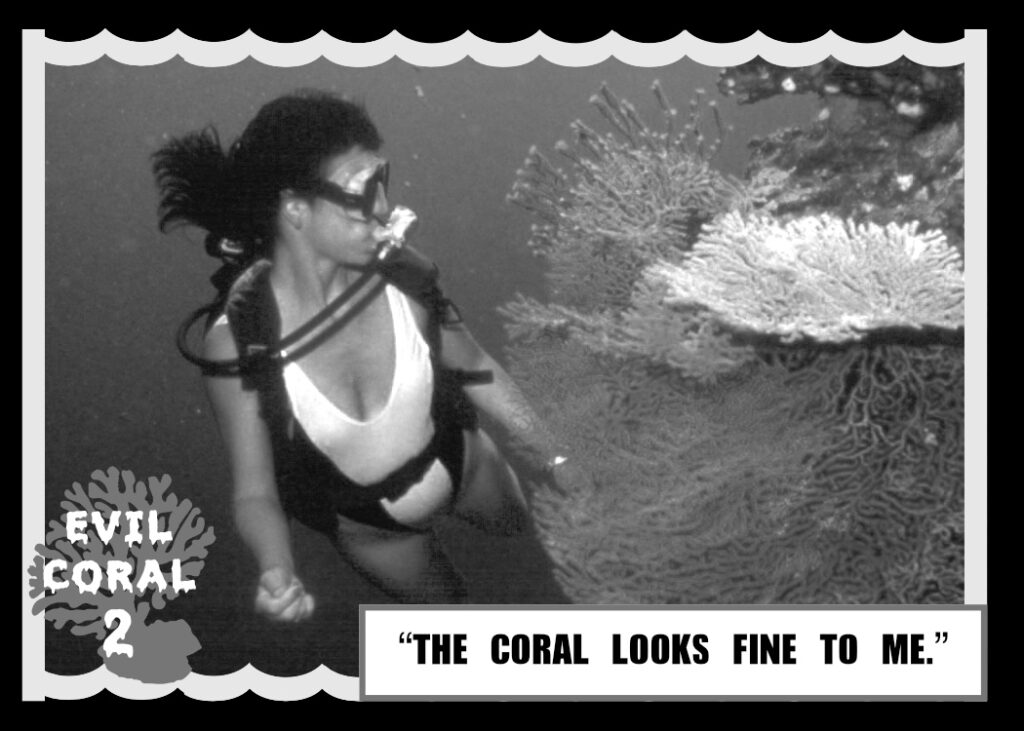
No, the coral isn’t fine, Stacy! That’s why the movie is called Evil Coral 2!
Of all the photos I found, this one where a cool kid is doing a special handshake with Santa was my favorite. I set it aside, because I didn’t have the concept right away. It clicked for me when I was looking through my card collection and found an anti-drug card from a DARE-like organization. Santa is leading that child astray!
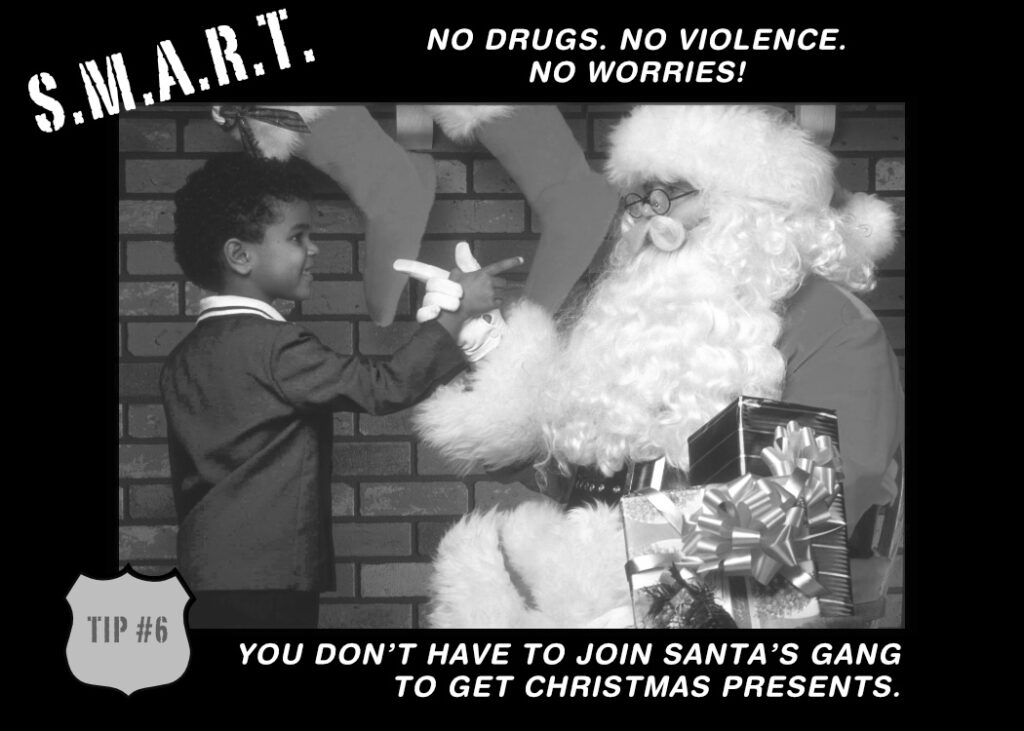
I brought the stock photos into Affinity, then looked up trading card design inspiration on Google Images. I used basic shapes, the Pen Tool, and specific fonts to try and capture the feel of the original cards.
Once I had the idea, it took me about an hour to make a card. For weeks, when I had a free hour, I would design a trading card and send it to Amanda via Discord. She was delighted to get my card drops and gave me excellent feedback. It felt like passing notes in class. My first comedy gig in Los Angeles was editing articles and making Photoshops for the National Lampoon website. The job sucked because the company sucked, but my colleagues were immensely talented and taught me a great deal.
I loved the process of making funny fake cards. I could do it all day.
Deep into layout, I asked my designer Mike what he thought of my card designs. He’s a top tier graphic designer who has worked for major commercial brands. I’m not a professional designer by any means, so I asked if they were embarrassingly bad or if they worked for the assignment. He ignored the question in his email reply. Uh oh. That bad? A week later, we had a call to discuss the layout and I playfully asked him again.
The comedian and now action movie star (!) Bob Odenkirk once said that he preferred Monty Python’s sets to SNL’s. They were a major influence on the production of his sketch series Mr. Show, one of my all-time favorites. The reason he liked Monty Python’s sets is that they weren’t polished. He noted they were so flimsy, they looked like they would tip over. And that’s what made them funny. A comedy sketch doesn’t have to look visually beautiful or perfect, it just has to look good enough to sell the joke.
So when Mike replied by saying, “If they looked too good, they wouldn’t be nearly as funny,” I took that as the highest compliment.
🎲 Your Turn: Are you a perfectionist? Are you comfortable with saying “good enough” and moving on? Can you think of a time you had to solve a creative problem in order to make your art? What trading cards have you collected? I’d love your thoughts! Reply to this email or leave a comment by hitting the orange button below.
2 responses to “The Card Collector to Designer Pipeline”
As I was reading through this, several ideas for trading cards came to mind:
Public Domain literature adapting illustrations from public domain printings.
The works of Shakespeare.
Various ancient mythologies, art taken from surviving art from antiquity.
Public Domain photos digitally rotoscoped for card art.
As for collecting, I’ve had small collections of the following in the past:
Pokemon TCG.
Pokemon Topps cards that were more in the vain of non-game trading cards.
A third type of Pokemon Trading Card that I think might have been part of some product promotion.
Some Gold-plated metal trading cards that came in PokeBall display cases.
Digimon TCG.
Digimon D-tector
Yu-Gi-Oh
Dragon Ball Z tcG
A few promos of other Shounen Jump Anime that tried to break into the TCG space.
Some Cartoon Network Trading cards, mostly from the era when they were mostly reairing classic Hanna-Barbara and warner bros. fair.
A few trading cards from Nintendo Power, including sets for Mario Kart 64 and starFox 64.
And while I was never into sports, I think I had a few of the classic baseball cards as a kid.
All of which was lost, damaged or thrown out in a fit of false maturity at some point.
My current card collection includes:
Numerous Tarot, Oracle, and Poker decks.
A few Decks of Many things.
A collection of Japanese CCG for Ojamajo Doremi… multiple booster boxes worth, more than half of the cards that were ever printed to my knowledge, though some have blue rarity markers, which indicates a card from an earlier expansion reprinted for a later expansion if i’m not mistaken. Also have a decks worth of what I’m pretty sure are chinese knock offs(the art has washed out colors, there’s no copyright text, the card text is all in Kanji instead of a mix of Kanji and kana, the cards are thicker with square corners instead of rounded ones) and the Japanese guide book that details the first two of the expansions… Though unlike Pokemon, Digimon, and Yu-Gi-Oh, where I at least learned how to play the game, I have no clue how Ojamajo Doremi’s card game works and as far as I know, there’s approximately zero info on it on the English internet.
My Doremi collection also includes some trading card-sized lamminated art cards as well as several pencil boards. Also, an interesting item in my Doremi collection is one of the few things that fits into both my Poker and Tarot collections… It’s a Korean inport based on the text but it actually came as two half poker decks, 2 suits, 1 Joker… but the jokers are also Fools and 21 of the 26 cards making up each color of suits are the numbered cards of the major arcana, So the Aces of Hearts and Spades are also the magician if memory serve with Hearts and Spades being I through XIII and Clubs and diamonds being XIV through XXI along with some cards with no Tarot label. So a deck that can either be used as a full poker deck or a pair of majors-only tarot decks… Plus, I think its like the only Korean thing in my collection not counting a few VCD/DVD releases of Korean animation.
Impressive collection! I love your idea for public domain literature cards. With the right design, I’d pick up a pack of those.