

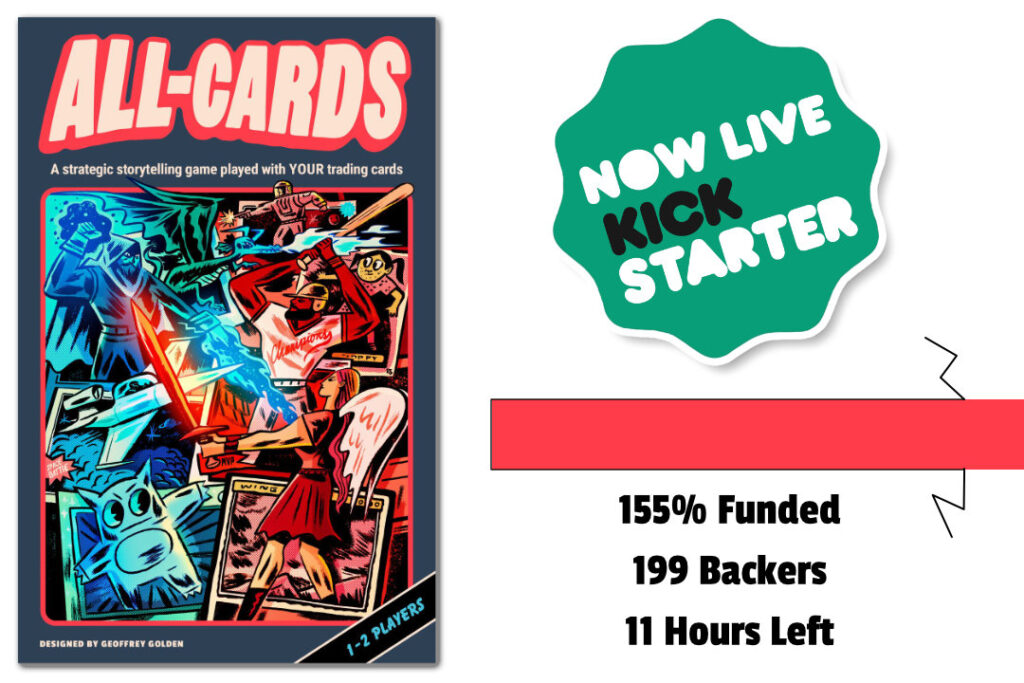
🃏 My Kickstarter for ALL-CARDS, the trading card storytelling game, ends today.
I’m excited (and relieved) to say we blew past the initial goal! ALL-CARDS is over 155% funded and still going!
🙏 Thank you for backing and getting the word out. It means a lot to me. I’ll talk about this more in a future newsletter, but I thought the least likely outcome for the Kickstarter was funding well beyond the goal. I’m very grateful and thrilled to bring ALL-CARDS to your table!
As you can see, I’m still getting the word out, even on the very last day. I returned to the hilariously nerdy War Rocket Ajax podcast to play a mock game of ALL-CARDS using Anastasia and Moebius cards. Anastasia stole a tank! ALL-CARDS was also highlighted by Cannibal Halfling Games on their Zine Quest highlights, plus I got video shout-outs from the creators of Barkane and Maps & Mishaps, fellow Zine Quest projects.
In case you haven’t backed yet, FYI: Today is your last chance to get your name in the zine, or get the digital version free with purchase of the physical zine. Here’s the link.
That was your final ALL-CARDS Kickstarter update. Now for the proper newsletter…

Glitch City is an awesome game dev hangout spot in Los Angeles. If you become a member on their Patreon, you can co-work from their offices. You’ll also get invites to their events. Before I had a full-time studio gig, I would go there weekly, but it’s hard to take video calls in an open workshop and not be super disruptive, so I had to stop. But there was one event last winter I knew I had to attend.
Every few months, Glitch City has BYOG playtesting events. Glitch City members bring their games to get feedback from other members. I’ve participated in this event before. Usually, I’m the one weirdo out of 20 devs who brings a tabletop game, instead of a laptop. This would be a perfect opportunity to kick the tires on ALL-CARDS in a major way as I finalized the game manual for the Kickstarter edition.
At Glitch City, the walls are covered with neon lights. There’s a custom built arcade cabinet in the corner. The bathroom is itself a game with a hygiene achievement system. Which is to say, the atmosphere is a little distracting for a humble tabletop game, especially when it’s packed at night like it gets during BYOG. But I always get helpful feedback from developers. In a night, I usually get in 4-5 playtests. Early in the evening, people are willing to invest 20 minutes into a tabletop game for the novelty. A few hours in, the playtesting stops and BYOG becomes a chill hang.
I placed several piles of trading cards on my four foot wide table in the corner of the main hall. One of the organizers kindly set-up a metal clamp light for me, otherwise I’d have to run out my phone’s battery as an expensive flashlight so the cards would be visible. I had piles of Indiana Jones cards, Gremlins 2 cards, Magic: the Gathering cards, Sliders cards, oddball wrestling cards, all organized by card category.
Categories? Yes, the way ALL-CARDS works is that players self-assign their cards to a category based on what’s depicted on them. A card showing Garfield is a “Character” card, whereas a card showing Garfield eating lasagna is an “Action” card. The five card types each have different abilities. So I figured giving players the opportunity to build their decks was a great opportunity to give them instructions on what the five kinds of cards do. Here’s the text of a cheat sheet I wrote out for players:
* Characters (People) – Every supporting Character on your side is worth +1 Triumph point (at the end of the game).
* MacGuffins (Objects) – Every MacGuffin on your side is worth +3 Triumphs.
* Settings (Places) – If your Setting is in play, draw 1 extra card. +2 Triumphs.
* Actions (Something Happening) – Remove a Supporter, Upgrade a Supporter, or Clear a Setting.
* Twists (Miscellaneous) – Steal a MacGuffin or Turn a Supporter.
One by one, I walked players through the game. How it’s a mix of TTRPG storytelling and light trading card game mechanics. You pick a Main Character and give them a goal, like curing cancer or reviving their local Bennigan’s. Then your opponent plays their Main Character and gives them a directly opposing goal, such as creating super cancer or building a machine to erase all memory of Bennigan’s. The game is about using your cards to further your character’s goals, or sabotaging the goals of your opponent’s character. At the end of the game, Triumph points are tallied and the winner’s character achieves their goal.
Unlike previous demos at Glitch City, ALL-CARDS attracted crowds. People were drawn to the piles like… well, 80s and 90s kids to trading cards, which was the whole idea. The table shows all these disparate characters interacting, which is funny in and of itself, but you also have players using their imaginations to tell competing stories about why Indiana Jones wants to steal Gizmo’s dimension hopping device. There were players who watched an entire game, then wanted to play for themselves, only to find they weren’t the first in line. Chris Zukowski, who writes a blog on indie game marketing, often talks about how certain games have a magical quality. The interest I was getting that night showed me ALL-CARDS had sparkle.
There was a lot of varied praise for the game, but one consistent criticism. The praise ranged from compliments on ALL-CARDS’ intuitive approach to gamifying storytelling, to the excellent balance between mechanics and imagination, to the rewarding finish of getting to end the story. But over the course of several games, I got the feedback that the mechanics were too complex. Specifically, it was hard for players to remember all the card abilities. Games like Pokemon and Magic solve for this by having the abilities written on the cards themselves. I didn’t have that advantage, because the whole concept was for players to reuse their existing cards.
I carefully observed playtest after playtest. I wanted to pinpoint the exact point of friction. People understood the idea of Characters easily. I place a Character to help the Main Character. MacGuffins weren’t an issue either. Those were objects that needed to be found and kept from being stolen. Settings were also not an issue. Players knew only one setting could be placed at a time and remembered to take an extra card if their Setting was in play. It was the Action and Twist cards that were giving players trouble. Those were the cards that sent them back to my cheat sheet again and again. What was it about those cards that were so tricky?
As I walked to my car in the dead of night, after hosting at least ten playlists, I couldn’t get Actions and Twists out of my head. I wanted Action cards to be about big dramatic moments in the story, like a character dying or coming back at the last minute to help the hero, or a big scene change. I wanted Twist cards to be about surprising turns in the story, like a precious object being stolen or a friend betraying the hero. In the cool night air, I had a sudden realization. Under a street lamp, I took out my reference sheet and read it with fresh eyes. Sure, maybe those card categories made sense thematically, but they didn’t make sense mechanically. I took out a pen and made a small, but significant change:
* Actions (Something Happening Supporter Moves) – Remove a Supporter, Upgrade a Supporter, or Clear a Setting Turn a Supporter.
* Twists (Miscellaneous) – Steal a MacGuffin or Turn a Supporter Clear a Setting.
The mechanical groupings were off. There were two different cards that did stuff with Supporters. If there was only one, Action cards, then it was much easier to remember. Action cards manipulate Supporters. Anything you want to do to a Supporter can be done with an Action card. Twists manipulate the other two categories, MacGuffins and Settings, by stealing them or clearing them.
In subsequent playtests, I didn’t get critiques about difficulty. Players didn’t need my cheat sheet anymore. I asked if the rules were too complicated and they said not at all.
One small change can be so meaningful to a game. The only way to find those friction points is through playtesting.
🎲 Your Turn: Have you playtested a game? Did you learn anything surprising or enlightening in the process? Have you playtested someone else’s game? Did you give good feedback? I’d love to hear from you! Reply to this email or leave a comment by hitting the orange button below.