


When I asked Nicole Amato, formerly the Games Outreach Lead at Kickstarter, whether creating a Kickstarter campaign could be fun, she told me about her late husband. The two of them ran a game publishing house together. He was an artist who enjoyed the challenge of designing enticing graphics to showcase their games in the best light. If she had to make the images, it wouldn’t have been fun for her, because graphic design wasn’t her creative passion. Luckily, it was for her husband.
Unfortunately, I’m like Nicole. I found the work of putting together the ALL-CARDS Kickstarter page to be an absolute slog. When I designed fake trading cards for the zine, I was combining a few passions: goofy parodies, 80s and 90s nostalgia, and puzzle solving, in this case finding creative uses for stock photography. The project clicked with my inner child. Not so with the Kickstarter page.
There are three main aspects to a Kickstarter page: the copy, the images, and the optional video.
Writing the body copy brought me back to my salad years as a copywriter, which I did to make ends meet while keeping a small press (my true passion) up-and-running with my wife Amanda. When it came time to write the body copy for ALL-CARDS, it felt like the fun part of making the game was over. Now I had to sell it. I rebelled against the assignment by throwing in weird jokes, like shouting out a dear friend in one of the reward descriptions and a McDonald’s theme song parody about the indie RPG Mork Borg. But at least writing copy comes naturally to me. Even counting rewrites, I probably spent about 3 hours total on the copy. Not fun, but easy.
I wanted the page to be full of visual interest, but I had already maxed out my modest art budget. So I imported the ALL-CARDS PDF into Affinity and ripped assets my designer drew. I re-sized and re-contextualized them into page assets. The whole process took me many hours. Before and after work, I designed and re-designed the page’s graphics. Sometimes I had to remake images because it turned out I got the size wrong. Sometimes an image looked fuzzy after it was uploaded and I couldn’t figure out why, so I started from scratch. ALL-CARDS’ cover looked awful shrunk down into the reward image size, so I used a simplified mock cover. My first pass on the images was black and white. I thought that would look zine-y and cool, but it didn’t “pop,” a common note non-artists give artists. So I remade all the graphics in limited color.
I started the page in earnest in early January and I got to a finished page layout by late January. I spent so long futzing with the page, I didn’t want to make a video. Hadn’t I already sunk enough time into this already? If simple graphics took me that long to make, there’s no way I’d have time to shoot and edit a whole ass video. I wrote two drafts of a script for a short, one minute campaign video in 2025. The first version was a motion graphics treatment, which is common in Zine Quest videos. Pan and scan over art. But unlike games with a fantasy or sci-fi setting, I didn’t have any sweet environmental art to work with, so the script was lacking. The second version was going to be a stop motion treatment, where trading cards moved themselves on a table. I liked that version a lot better than my first take, but I’d never made a stop motion video before. All I knew was that the process is famously time consuming.
I decided not to bother with a video… but like all things, “playtesting” changed my mind. Amanda and I hosted a website updating party. We’re friends with a lot of creatives who have portfolio websites they forget to update. Us very much included. At the party, I had two friends look over the Kickstarter page at a party, and their comments indicated to me that seeing gameplay was crucial to selling the game’s concept of using any type of trading card. I thought of how appealing the game must’ve looked at Glitch City. I needed to show Marvel cards fighting Magic cards using Muppet cards.
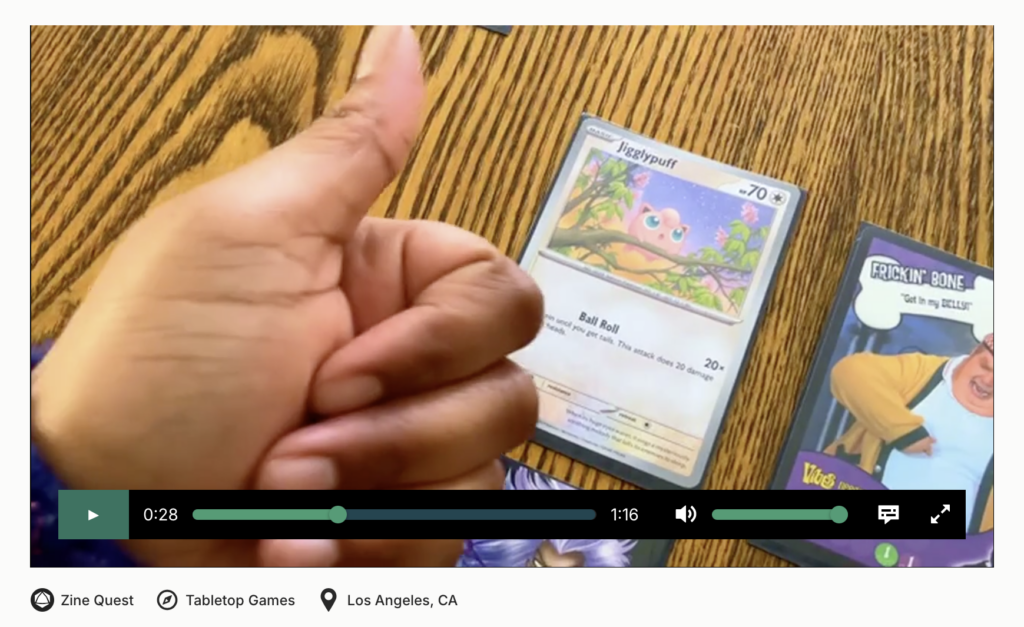
Since I didn’t have another eternity few weeks to spend on graphics, I decided a video was the best way forward. I rewrote the script again, taking what I liked from the previous draft, but instead of stop motion, I made the conceit hands moving cards on a table. No faces. That way, it’d be easy to dub the voices for better sound quality. I wrote the parts for Amanda and I, as stylized versions of how we play the game.
The Saturday before launch, I dug out my tripod and the cell phone holder that connects to my tripod, a neat little trinket I got for free from eBay’s booth at New York Comic Con. (I was probably the only person at the show who geeked out for the eBay booth. “Oh my god, eBay! I love saved searches!”) Both Amanda and I went to film school, so the project brought back ancient memories for us about key lighting and proper framing. Amanda and I cleared the dining room table. We shot during the day, when the living room has a lot of natural lighting, so we only needed minimal additional lighting. We put down one of the leafs to get the tripod as close as possible to the cards on the table.
It took a few rehearsals, but we got the movements down for our wide master shot. Basically, we shot the entire sequence in wide, then we shot close-ups on all the individual actions in the script, like Amanda turning a Fat Bastard card to its side or me playing a Dinosaurs trivia card on a Star Trek data disk card. One disappointment was being unable to keep the tripod steady and perfectly positioned for the close-ups. We ended up taking turns using the tripod like a boom mic over the cards. I knew that would look different from the steady master shot, but time was ticking and it’s not like I owned a Steadicam.
The whole shoot took about three hours, including the voice over session where we recorded our dialogue. I have a nice USB microphone in a cardboard box surrounded by sound-proof foam, which produces a reasonably clean sound. Amanda made a few of my jokes funnier with her delivery. She’s gifted at plus-ups.
I woke up early the next morning. While Amanda slept in on Sunday, I finished a cut of the video in DaVinci Resolve. There wasn’t that much footage to sort through. I regretted using my iPhone SE 3. The image quality looked potato-like in the edit. Maybe I didn’t adjust the settings correctly. Like all video shoots, there were shots I wished I got but didn’t, like a longer shot of panning between Freddy Krueger and ALF. I had to chop my script a bit to fit the shorter hold on ALF than I needed, but the addition of a “cha-ching” sound effect over ALF in a business suit was Amanda’s smart solution.
Grumblings aside, when it was all said and done, I really enjoyed what we came up with. Narrating a story over vintage trading cards turned out to be very funny, like a low-fi version of Robot Chicken. There might be something to that as spin-off project. The royalty free film music added to the absurdity, exactly as I’d hoped. The process of collaborating hand-in-hand (literally!) with Amanda was very fun. It always is! The weekend brought me back to my college years of shooting a sketch comedy video the night before the live show. Many of my dream project ideas revolve around shooting video, so I’m glad I still find the process fun.
All said and done, making the Kickstarter campaign assets was a mixed bag. The copy and images were arduous exercises in marketing. However, the video was a fun throwback. But all of it was just a prelude to The Big Show: the campaign itself. My feelings about ALL-CARDS would be influenced by how well the Kickstarter funded. In just a few days, I would hit the button and launch. The project was ready and I was pretty nervous.
🎲 Your Turn: Is there a creative project you want to do, but haven’t had the chance to tackle it? How about a creative discipline you used to do all the time, but haven’t used in a while? I’d love to hear from you! Reply to this email or hit the orange button below to leave a comment.