
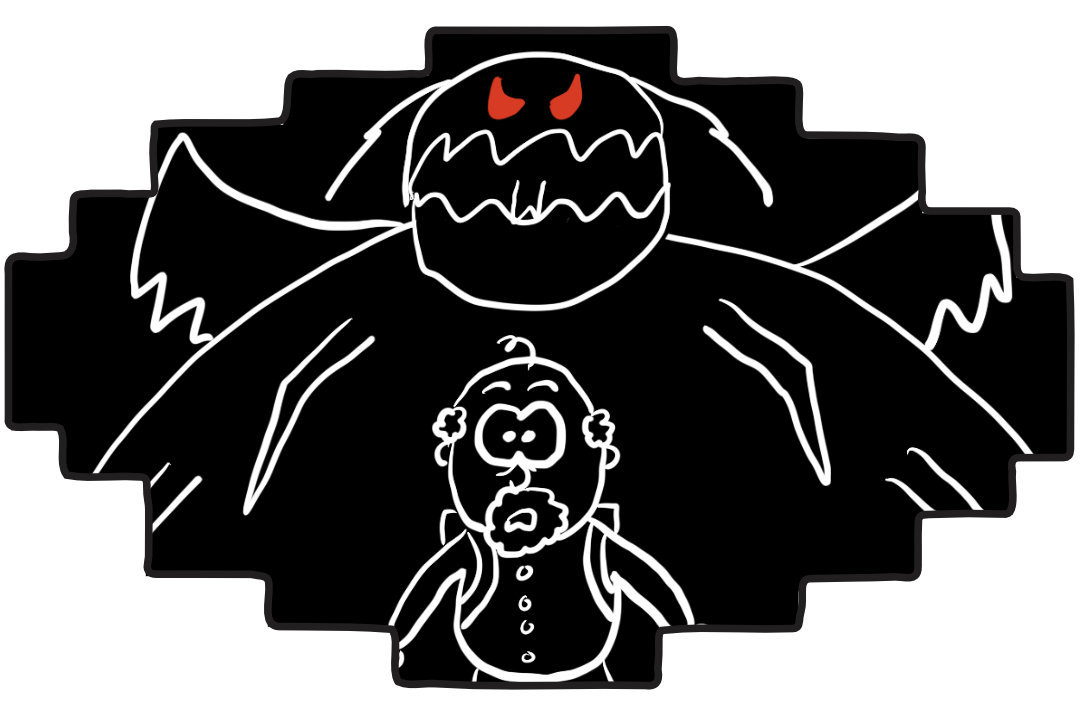

🕷️ This newsletter is all about making The Bug Guy, the interactive comic adventure game I released last week. Play it on Itch.io!
I’ve been drawing for my job. I can’t believe it either.
In elementary and middle school, if you had asked what I wanted to be when I grew up, I would’ve said cartoonist. I took art classes, read cartooning books, and practiced drawing. I drew a comic strip about an alien named Bemo with barber pole eyes, inspired by the Garfield, Calvin and Hobbes, Far Side, and Bloom County collections that filled my shelf. I was an ambitious kid. My first professional rejection letter was from United Features Syndicate, regarding a weekly comic pitch starring Bemo I drew with colored pencils. I think I was 10? They suggested art lessons and weren’t especially kind about it. As I got older, I noticed my art skills weren’t improving. I blamed my inability to comprehend human anatomy on a scientific level. However, my writing was very well received by teachers and classmates. I got a recurring column in the school paper as a middle schooler in a 5-12 school, which was unheard of. The column won an award in Syracuse. (The big time!) I made a choice to focus on writing and leave cartooning behind.
Over the course of this year, I’ve been storyboarding for work at Doborog. I wrote cutscenes for an upcoming update to Clone Drone in the Danger Zone. In order for the team to animate them the way I envisioned them, I drew storyboards of all the sequences. I know my strengths as an artist. My art style isn’t slick or pretty, but I’m good at panel composition and communicating ideas. It’s the same with me and karaoke. I don’t have a good singing voice, but I can sell a song to the point that a random audience member once gave me their business card after singing “Copacabana.” They weren’t in the music business or anything. It was weird!
The storyboards for the cinematics went over so well, my creative director Erik asked me to draw UI storyboards for our upcoming game, a strategic space battler. So when it came time to pick a project for the summer Doborog game jam, I knew I wanted to hand draw a game. It’d be a good opportunity to practice drawing, a skill that would help me pay my bills for the foreseeable future?!
I had the idea for the game itself in Toronto. My favorite comic convention is the Toronto Comic Arts Festival (TCAF), a show where the best cartoonists from around the world come to exhibit their comics, zines, graphic novels, and art prints. The creativity, talent and passion on display is so inspiring. During the show, I thought about how much blood, sweat, and tears goes into a self-published graphic novel. It made me wonder: if that same amount of an artist’s time and energy went into a comic game, could it reach a wider audience on Steam and earn more? I know that’s not the sort of art for art’s sake reasoning I usually have for taking on a project, but I think it comes out of love for the artists in my life. Comic page rates are pretty much the same since the 90s. Nightmare industry!
I decided to experiment with an interactive comic format. Imagine an adventure game with inventory and puzzles, but displayed in panel. As you interact with the game, the upcoming panels change. The player rewrites and re-draws the story as they play. I decided on a space station horror theme to dovetail with Doborog’s next release (a turn-based strategy game in space). The player character would be an exterminator hired to kill a monster bug in a space station. I wrote a quick and dirty outline and called it The Bug Guy, but decided to draw the story on the fly, since that worked well for my last jam. Here’s the day-by-day account of how it went…
Day 1: I got off to a strong start. My first instinct was to draw the storyboards, but then I realized if I can’t get the actual game mechanics to work, those storyboards would be a waste of time. So I set about making a simple prototype. I drew 3 mock panels with a clickable door button and sliding starship doors on separate layers. Then I imported the assets into GDevelop as sprites with button attributes, so they could be clicked on. Everything worked pretty much as I hoped it would. When I clicked the door button, the doors slid open. It was easy to program.
It took an hour or so to figure out how the game’s navigation system would work. After trying and throwing out a few ideas, I decided all the panels would be laid out in a row, like a comic book. A single panel would be centered in frame with forward and backward buttons to let the player navigate from panel to panel. The game’s camera would jump to the location of the next appropriate panel. For example, depending on what the player did in panel 3, the forward button might jump them to panel 8. GDevelop has a super easy way to follow a player character jumping around on screen in a platformer, but moving the camera dynamically to different possible locations wasn’t as easy to grasp. With the help of Scarlett, Doborog’s lead engineer, we came up with the idea of using a list of X-coordinates for all the panels and having the camera go to those hard-coded locations. I knew it would take a while to get all the X-coordinates listed, and that was time I wanted to spend polishing. I suspected there was a simpler solution…
Day 2: Confident enough in my prototype, it was time to start the branching storyboards. I made a bunch of stick figure drawings in tiny boxes, large enough so I’d get the general idea of what was supposed to happen. Many panels branched into two depending on the player’s actions. The story diagram was very messy, but I only had to understand it for a few days. Game jams!
One idea I wasn’t sure about was a navigational fork where the player can go to one of four different rooms in the ship. It was a simple idea, but I suspected it would require breaking the game into multiple scenes, then making the camera feel like it seamlessly went to the next panel, when it fact it was jumping scenes. Not impossible? But that wasn’t part of the prototype, so I didn’t know if it would work. In the interest of giving the player more agency in the story, and making the puzzle feel puzzlier, I would give it a try.
I got done with the storyboards in, like, two hours! I thought it would take me the whole morning, but a lot of these ideas were brewing in my head since TCAF, so the story just poured out. I made it through 80% of the panel art by Tuesday. The art style was black & white and cartoony. It was very much inspired by mini-comics (aka “ashcans”) I used to draw and perfect for a game jammer with limited time and even more limited art skills. I’m not the biggest fan of my own art, but part of this exercise was about learning to love and embrace how I draw. The kid cartoonist in me was thrilled to work on this! I drew a style sheet for my main character – a bald, middle-aged, intergalactic bug exterminator – and I was proud I thought to put his ears opposite his nose, the way human faces typically work.
Day 3: I blazed through the rest of the panels on Wednesday morning. It probably looks that way, too! For a week long comic jam, I think the art looks just fine. I remembered a few tricks from years ago when I took a cartooning class as an adult, like tracing over previous illustrations for consistency and drawing stick figure poses to get proportions and camera angles right. I’ll do a better job with my next storyboard assignment thanks to this jam.
I thought the hub would be a problem. I was 100% right. I tried to make it so the hub would flow seamlessly, but it created too many logical inconsistencies with hints of the panel art in front of and behind it. In order to make the hub work, I had to make the hub panel its own scene and disrupt the flow of the comic. I leaned into that choice by giving the hub panel a black background, adding fades in and out of the scene. I made the sequence a moment. I spent way more time on the navigation on Wednesday than I thought I would. There are five “chapters” of panels. By the end of Wednesday, I had successfully coded 1.5 of them. Oof!
Day 4: I got an early start, but the morning was full of coding landmines. The logic of the navigation was the bugbear of the project. If I had a story with no scene branching, I would’ve been home free by Thursday with time for polish. There were a lot of bugs with the navigation system. Every time I thought I fixed them, something else broke. But over the course of the day, they got closer and closer to working as expected.
I managed to code up to chapter 4 by the end of the day. One thing I never appreciated was how much bespoke coding goes into a puzzle-based adventure game. Every unique puzzle provided unique coding challenges.
On Thursday, I hoped and prayed for a better night of sleep than I got the night before, so I could kill all the (literal and figurative) bugs. At the very least, I wanted to finish chapter 5 and have a technically playable game from start to finish. Best case scenario, I would finish chapter 5 and fix the remaining navigation bugs by lunch. Then I would’ve had the afternoon to add music and sound effects. To give the game that point-and-click adventure feel, SFX would be killer.
Day 5: I didn’t have time for those killer SFX on Friday, lol. At 5:30 pm, I posted to Slack that my jam game was technically beatable and therefore I had succeeded. All five chapters worked as expected. Minus music and sounds, the game was pretty much as I imagined it. The hub system worked. I even added nicer crossfades. The multiple endings worked. Once I got past one of my trickiest designs, the password system preventing the player from going right into the main boss room, the rest fell into place.
I showed a bit of gameplay to my friend Erik Barnes, a very funny writer and performer, during my lunch break on Friday. He really dug the design and thought it was inventive. I said the hub was a pain-in-the-ass, but he said it was worth it. I agree.
Day ???: The following week, in my spare time, I added the music and sound effects The Bug Guy was desperately missing. It made a world of difference. The game instantly felt like a game. Our 9-year-old nephew Karim stayed with us for a week and he loved The Bug Guy. He wanted to speed run it again and again. He even helped me catch a few more bugs. He’s a good playtester!
Jam week is about learning by doing. I learned I can make a pretty complex and ambitious project in a short amount of time. I learned my art can still improve with practice. And I learned that I still have a place in my heart for cartooning. Not just buying comics, but making them too, especially in strange new forms.
🎲 Your Turn: Do you draw? What kinds of stuff do you draw? Did you have an art practice you enjoyed as a kid, but grew out of? Have you ever tried picking it back up as an adult? Where do you go to get artistically inspired? I wanna hear from YOU! Reply to this email directly or leave a comment by hitting the orange button below.
Leave a Reply